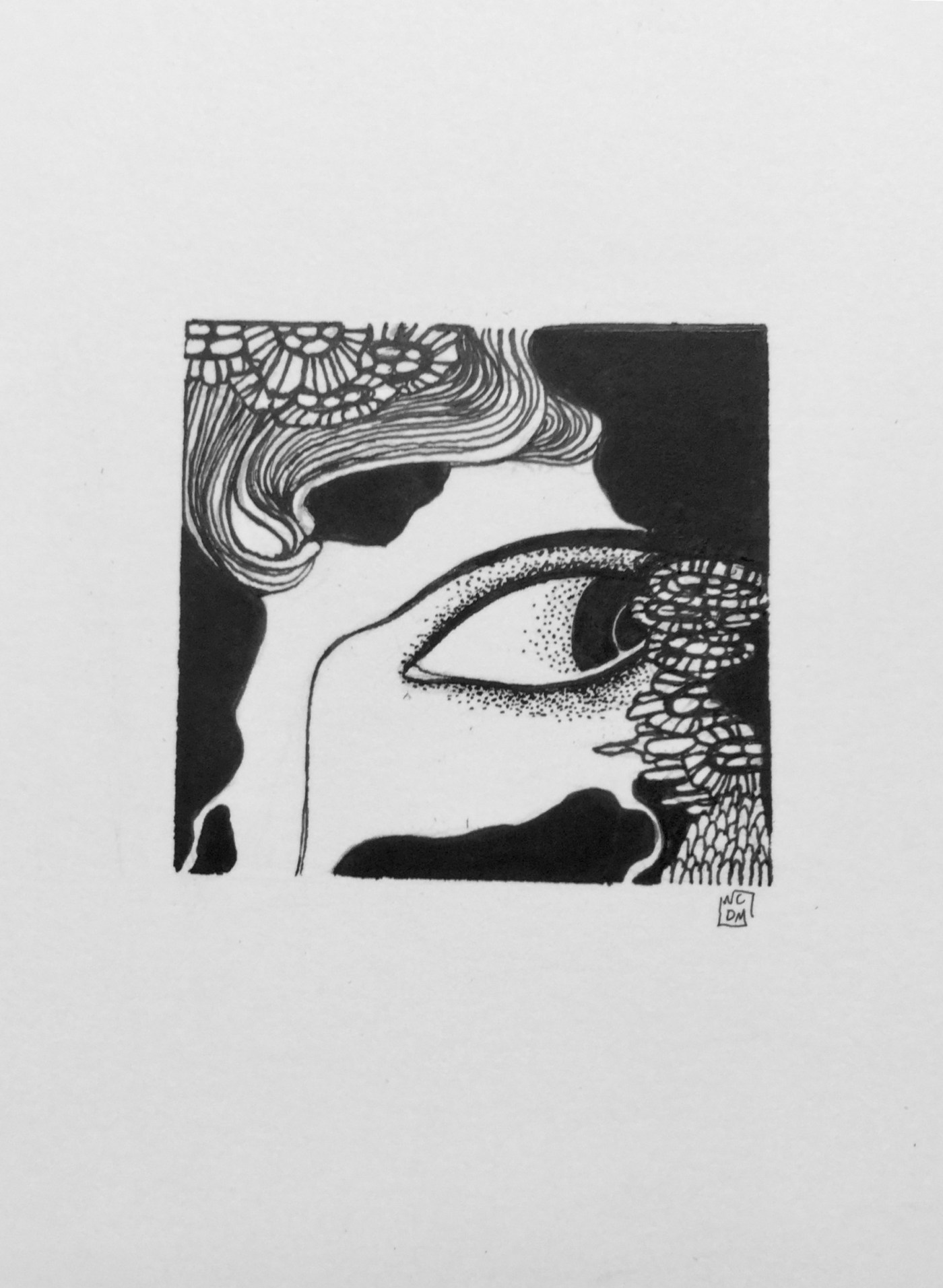
A Time for Story: Inspired by Shakespeare and Hamlet Illustrated by John Austen
Ink and India ink on paper

As children, we soak up the culture and world around us, instinctively and knowingly. In the first few years of our lives, we learn what is essential to human interaction, we learn to communicate, to use our body, to think. We also learn to observe as we acquire cravings for excitement and comfort, for beauty, for fulfillment.
Much of this observing comes our way through story, from our families and communities, from folklore and fairy tales. What the world immediately surrounding us lacks, stories fulfill, reviving our senses of wonder.
As a child, I found myself craving story with such a vengeance that I was soon absorbing stories “above my level.” In part, this is due to my parents trusting that children can comprehend more than we give them credit for and because some stories were able to capture and express the beauty, mystery, and vastness of the world around me.
When I must have been about three, I was terrified by cartoons and their invasive loudness. So, I turned to stories of a slower pace that gave me room to process. And that is when I fell in love with Shakespeare’s faeries–one of my favorite movies was the 1999 version of A Midsummer Night’s Dream.
The sensuousness of the fairies, the fierceness of Titania’s gaze, Puck’s raucousness, and later, the lover’s complexities and comedy seemed to slowly untangle the world around me. Similarly, Shakespeare challenged me to decode and deduce a language that spanned across time, expressing the beauty of communication.
When I was older, my love of story led me to try out acting Shakespeare, my first role being Peaseblossom, one of Titania’s faeries. In those moments, communicating a story that long gave me comfort, I found the world and my imagination colliding.
In the years following that first enactment of Shakespeare, I dove into his words, studying First Folio over Skype with an actress in Chicago. At that time, Shakespeare’s words were ever-present: a quote written on the wall in my house’s stairwell, the books on the shelves, and the copy of Hamlet illustrated by John Austen that reminded me of the magic I sought as a child.
Shakespeare’s work guided me as I processed life around me and within me. His work inspired me to explore the world, his work inspired me to express my thoughts, and his work showed me that with dedication, words—communicating—could become poetry.
As I entered my adolescence, acting turned into a craving to translate the world, to connect not just through someone else’s words and directions but through my own. Perhaps this signified a part of me growing up: childhood is a time for absorbing, adolescence is a time for exploring others’ stories, and young adulthood is a time for telling our own stories.
And perhaps, once we’ve come to terms with our own stories, the rest of our lives are for learning how to explore again, one story, one person, one eye at a time.

276 days done, 89 to go.
 NadiaCDM