
Salvador Salort-Pons: Inspired by Velasquez and the Interconnection of Stories
Graphite on paper

We need to tell our stories because sometimes all it takes is hearing a story–and seeing the subsequent connections–to gain the courage to tell our own.
It was cold, it was dark, and the rest of the museum was closed. My family and I carried with us a nostalgia that fueled our anticipation. We had wanted to see the Star Wars Costume Exhibit for years, but life, and health, changed our plans, twice.
While it’s a cliché, the third time was the charm. We got the very last tickets to the very last exhibition at the very last location because we, here is another cliché, happened to be in the right place at the right time.
My adolescent adoration for Star Wars grew from the movies’ campy atmosphere and the archetypes I could trace back to numerous characters in the literature and mythology I loved. While Star Wars seemed to tap into some of Carl Jung’s collective unconscious, I wondered whether humanity’s similar stories really did evolve from a collective unconscious or if our stories appear to be so connected because they are just that: connected.
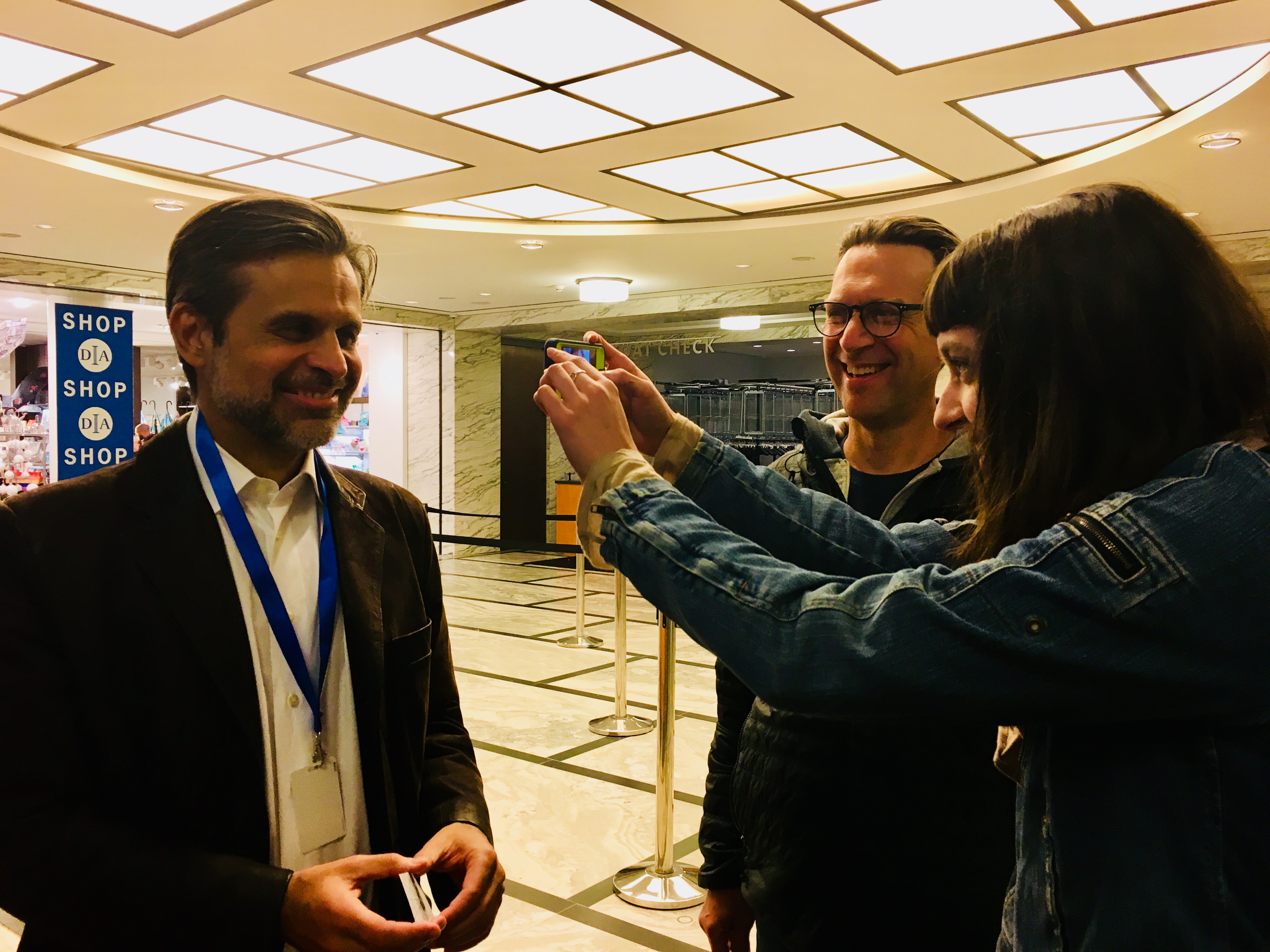
Back to the clichés: that night, in the lobby of the Detroit Institute of Art’s main entrance, the one off of Farnsworth Street, many stories in my life converged.
As we checked in at the front desk, I recognized one of the only other people in the lobby, Salvador Salort-Pons, the Director of the DIA. I am not only a lifetime lover of the DIA but also a member who had just finished reading the DIA’s newsletter, so his face was familiar.
My family, being my family, introduced ourselves. And then we began to share stories. My mom recounted how, as a child, she took a clown face-painting workshop at DIA, and by sharing (even if it may have embarrassed my sister and me–just a little), she prompted Salvador, who was far from embarrassed, to share his own clowning story. In fact, he lit up, opened his phone, and scrolled through his Twitter feed to show us that he, himself, is a champion of clowning, donning the face paint, and honoring the culture regularly.

The stories wound around each other through time and connected to CognEYEzant:365. I asked him to be a subject. And he said “yes”. And I asked him, as I do with each subject, who his favorite artist is. He responded Diego Velasquez.
Later, after the exhibit and once I was home, the connections continued. I learned that Salort-Pons has a history full of Velasquez’s work (to learn more, click here), including the painting “Pope Innocent X.” Which I knew from The Art Assingment’s video “The Case for Copying.” In which we learn that “Pope Innocent X” inspired Francis Bacon’s “Study after Velázquez’s Portrait of Pope Innocent X.”
Copying is an explicit form and expression of interconnected ideas. Copying art brings with it the context of time and space, the context of the artwork, and the artist. In other words, with copying comes story. And so, as I copied Salort-Pons’ eye over and over in my sketchbook and thought of Bacon copying Velasquez’s work, my own story, this story, wound itself together. And here we are now.
I think our world is built on the repeated stories of individuals. We need to tell our stories because sometimes all it takes is hearing a story–and seeing the subsequent connections–to gain the courage to tell our own.
198 days done, 167 to go.
 NadiaCDM