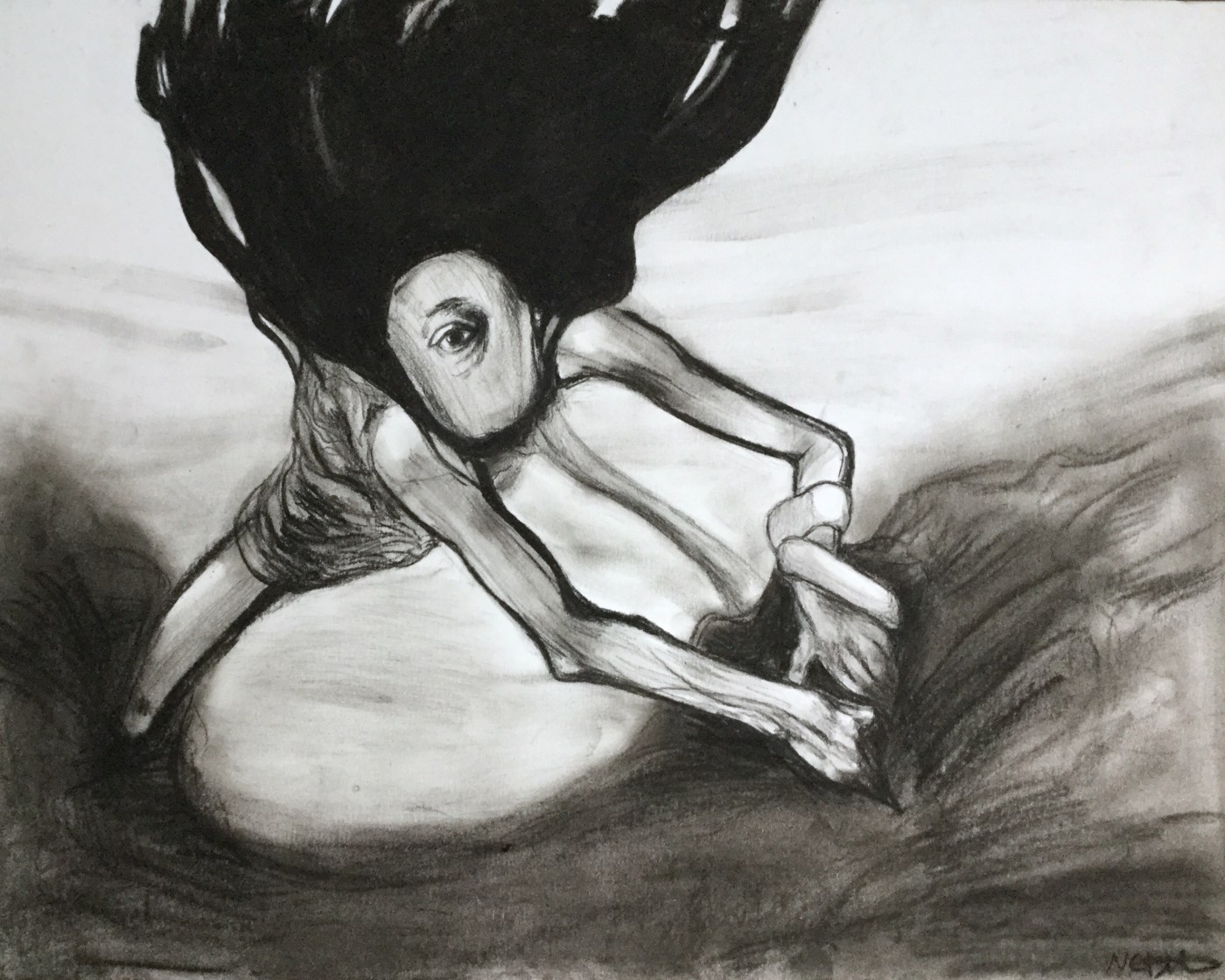
Lookinglass: A Study Inspired by Käthe Kollwitz’s “Death Grabbing at a Group of Children”
Charcoal on paper

And I think art impacts culture by defying culture, by simply handing culture a mirror.
I adapted this piece from an essay I wrote for the final of MoMA’s Coursera Massive Online Open Courseware (MOOC) Modern Art & Ideas. We were tasked to correlate an artwork to the class’s themes, and with what time and resources I had, I dove into Käthe Kollwitz’s “Death Grabbing at a Group of Children.”
German artist Käthe Kollwitz (1867-1945) created work that reflects parts of the world we may not choose to see, the almost mundane, yet no less palpable: grief, sorrow, darkness. The loose, purposeful lines and large hands of her subjects ground the stories Kollwitz illuminates, making the act of looking away from her work nearly impossible. I cannot look away from her lithograph “Death Grabbing at a Group of Children.” The piece reflects Kollwitz’s inner turmoil, a turmoil caused by that of the culture around her.
Despite Kollwitz’s supportive family, one that would rather see her attend art school than marry, she was followed by a darkness. This darkness courted her as she created a family. It found traction as she navigated two world wars and came to fruition in her grief, but this darkness was only expressed in her artwork.
The Diary and Letters of Kaethe Kollwitz, edited by her son Hans, touches on some of the artist’s carefully secluded interior life. In the book’s introduction, Hans Kollwitz reflects on how his mother rarely talked about herself, yet her writing implies that she could express herself through other people’s stories through her artwork.
Diving into her history, I don’t think Kollowitz’s art could have its potency without her relationship to death itself. Her son Peter was killed in the First World War on October 22, 1914, an experience that shifted Kollwitz’s perspective. Her diary entries after her son’s death turn from simple recounting to exploring the existential. In a diary entry from December 1915, she writes,
“The idea of eternity and immortality doesn’t mean anything to me at present. The spirit of Peter goes on living. True enough—but what does this spirit mean to him? The great world spirit which entered into him and which goes on working after its dwelling is shattered—that is something not conceivable […] That is why for me there is no consolation at all in the thought of immortality.”
“Death Grabbing at a Group of Children’s” dark, unclear lines coupled with the faceless Death illustrate grief’s personal, roiling emptiness. Looking at it through the lens of history, I wonder if the piece is perhaps a herald to the future: in September of 1942, her grandson, perhaps fatefully named after his late uncle Peter, would die fighting in the Second World War. Then, her longtime partner and husband would die, and Kollwitz herself passed away only 16 days before the war’s end.
Kollwitz’s story and grief, her darkness and expression, coupled with that of the people and culture around her, made art that hurts just as it heals. Her work shows that art can express the future through the urgencies of the present because no matter how much culture changes, much stays the same. And art has the uncanny power to capture that sameness and translate it through our differences.
Kollwitz had the ability to translate and express the existential, the personal, and the cultural through her artwork. And with every Kollwitz piece I come across, the intrinsic relationship between art, culture, and our individuality becomes clearer.
Art can be beautiful or unsettling when we observe it within our own perspectives. Art becomes more meaningful to us when we learn of its origins, symbolism, connection, isolation–all beyond its aesthetic surface. I think art impacts culture by defying culture, by simply handing culture a mirror. First, though, we have to examine ourselves in that mirror and learn to translate ourselves.
______________________
I first fell in love with Kollwitz’s work when I watched this video from The Art Assignment.
176 days done, 189 to go.
 NadiaCDM