
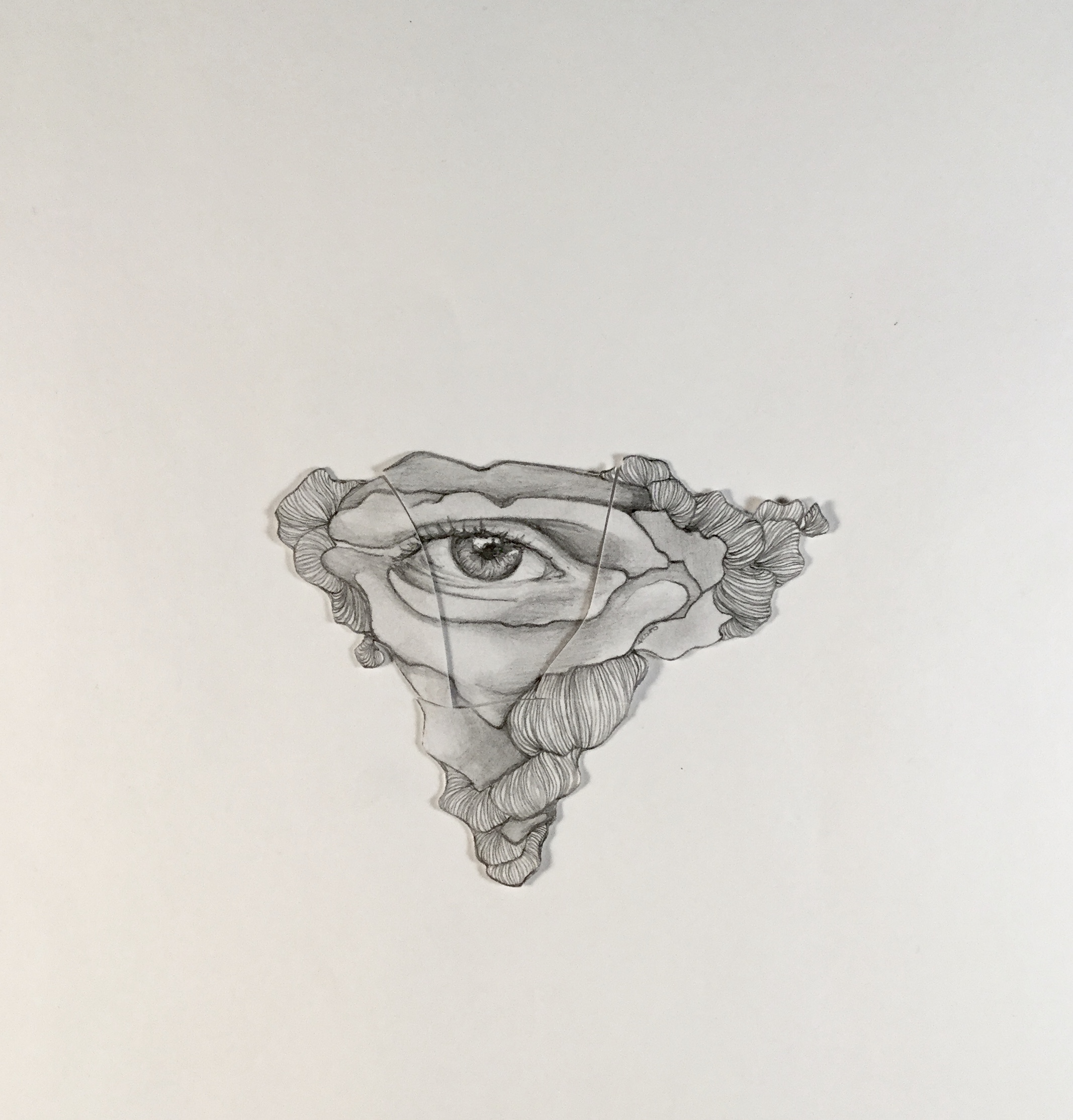
Directional Exploration by Way of Fragmentation
Graphite on paper, animated.
The Creative Meanderings #3: Exploration, Direction, and Trying to Make Sense
the best guides are the ones that unfold alongside us
Three hundred sixty-five pieces is really a lot of art, a lot of time, and a lot of change. And somehow, through this process, each piece needs to be cohesive to a greater whole, to the project. Just like we as individuals have to coexist with each other in our uniquenesses.
Something I’ve learned about people is that you can’t force them to thrive. You can’t tell someone to be happy or feel fulfilled; fulfillment takes effort, time, and lots of growth. Something I’ve learned about art is that you can’t force it to make sense. While there is a lot of skill, practice, and discipline involved, there is also an organic sense, perhaps genuineness, that just can’t be forced.
For the first quarter of CognEYEzant:365, much of the art was fairly reactive. I wanted to see and explore the art, to learn what was genuine and how to translate what I saw into something others could also see.
While sometimes the lack of “direction” in coming up with a new concept every day was fairly daunting, this fluidity also led me in a very specific direction. While I couldn’t help but wish to have a guide to adhere to, I realized, after many trials and errors and even more doubts, that the best guides are the ones that unfold alongside us.
In the world of academia, a thesis resembles this guide, this direction. Most people who’ve experienced writing or trying to write an academic essay know that the thesis is this enticing and elusive dichotomy between constraint and freedom. You should have a thesis before you begin writing because it helps, but sometimes it doesn’t.
When a thesis doesn’t work, that may be because you don’t quite understand what you are trying to express. Essentially, it takes exploration to find the direction. In his guide to literary nonfiction, To Show and To Tell, Phillip Lopate, author and critic, elaborates on how to explore an idea. He writes that,
“it puts unreasonable pressure on students to ask them to generate a thesis before they have explored their thoughts on the page.”
Maybe we won’t understand or even see our direction, but with exploration, we might be able to figure out what direction we are going in. And this is where people and art are similar: we have to be open and explore each other before we come to or even decide to form conclusions. It’s not easy, but it works.
__________________________________________________
Creative Prompt: Make Some Sense
- Set a 25-minute timer and either write or draw with no preplanned ideas of what you are creating.
- When the timer is up, try to find a thesis, a direction, a point in what you created.
- What did you discover?
- Share your discovery.
163 days done, 202 to go.
 NadiaCDM